Saturday, 31 October 2009

Priory Church of St Mary and St Blaise, Boxgrove


Boxgrove Priory is a magnificent church for such a small village. It was built soon after the Conquest by the Benedictine monks of Lessay in Normandy, and became the parish church at the dissolution of the monasteries in 1536.
All monastery churches that also served as parish churches were divided into a part for the exclusive use of the monks, and a separate area for the laity. At Romsey Abbey, the parishioners used a north aisle and in Chichester Cathedral the locals had to make do with an altar in the north transept. At Boxgrove, the parish had most of the nave but were separated from the chancel, tower crosssing and transepts by a stone screen called a pulpitum which enabled the monks to keep their seclusion.
At the dissolution, the parish moved into the grander chancel, the pulpitum was built up to the vaulting and the old nave was mostly demolished. Today, only a few bays exist, dating from about 1170.
The old chancel, built in about 1220, is a cathedral in miniature with stone vaulting and elaborate stonework. Outside, flying buttresses prevent the vaulting from spreading outwards and collapsing, but they are also very impressive in their own right - almost like sculpture.
The chancel arcades are arranged with two arches inside a bigger arch. Above, a lancet window and two blank arcades are squeezed under the stone vault. The arrangement is very unusual, only seen elsewhere at the retrochoir in Chichester cathedral and the chancel of the church that was to become Portsmouth cathedral.
The details are pure Early English, dating from about 1220. The mouldings on the arches are deep and complex, and some of the columns have become clusters of slender attached columns of Purbeck marble.
Another link with Chichester is the floral decoration on the vaulting, which was painted in the 1550s by Lambert Bernard, who did a similar job in the Lady Chapel at Chichester as well as the huge paintings in the transepts.
Boxgrove is reaching the end of a huge restoration programme and is expected to be re-opening in the middle of October.

Wednesday, 28 October 2009

Churchyard Yews


Legends abound to explain the yew trees that flourish in most English churchyards. Some say they were planted to supply wood for longbows, others that their poisonous leaves deterred livestock from trampling across the consecrated ground.
The truth is even more extraordinary - the yews were there before the churches.
Yews were sacred to the Ancient Britons, who regarded them as symbolic of the cycle of life because they live for hundreds, possibly thousands of years and, being evergreen, they do not 'die' in the winter. Yews were often planted in sacred groves in the woods, away from settlements, especially in Sussex.
When Christianity arrived, Pope Gregory advised missionaries not to destroy the sacred groves but to build churches there, and the tradition of planting yews in churchyards was established. Some of the ancient pagan trees still survive - the Fortingall yew in Scotland is between 2,000 and 5,000 years old. Local legend says the the infant Pontius Pilate played in its branches!
Yew for longbows was taken not from churchyards, where they were protect by their consecrated status, but from the forests. Military demand was such that by Elizabethan times yew had been wiped out throughout Europe, and might now be extinct but for churchyards.
Longbows were more accurate over longer ranges than Tudor guns - guns were adopted not because they were better but because suitable bow wood was unobtainable.
The majestic avenue of yews at Westbourne church was planted at the end of the 15th century, and is claimed to be the oldest in the country.

Wednesday, 2 September 2009

St Mary Our Lady, Sidlesham

The most lavishly decorated part of most churches is the chancel, but somehow Sidlesham has lost what must have been most impressive feature.
The church was originally built in the early 13th century in a cross shape, with a pair of transepts and a tower at the crossing. The chancel must have been imposing as it had side aisles, very unusual in a parish church.
The tower was the first to go, probably in the 15th century when the new tower was built at the west end. The chancel was pulled down in the late 17th century, leaving the church a strange T shape.
The only traces of the chancel are fragments of the pointed arches that led into the aisles, now set into the wall like fossils in a cliff. The new east window was cobbled up out of 15th century tracery from the old chancel, which looks lovely from the inside but from the outside protrudes from the east wall in a very odd way.The reasons for the disappearance of the church's finest feature are lost in time, but it may have been something to do with disputes over maintenance costs.
In medieval times, the parish paid for maintenance of the nave, but the rector was responsible for the chancel. He paid for it out of income from tithes and the glebe, farmland owned directly by the church. Could some 17th century rector of Sidlesham have decided he had better things to do with the money than prop up an old chancel, and simply left it to fall down?
This theory gets some support from the fact that tow small square stones were let into the columns at the end of the nave, inscribed: "Chancel Boundary 1814", clearly a reminder to the rector that he still had some financial responsibilities.
Chancel repairs would be a forgotten detail of medieval church finances if it were not for a succession of legal twists that make it a hot topic even today.
In late medieval times, monasteries began to buy up the right to appoint rectors, known as advowsons. They would wait for the current rector to die, appoint one of their own monks and appropriate the rectory, glebe and tithes. It was a very profitable diversification of their core business.
When the monasteries were dissolved in 1536, Henry VIII distributed their property to institutions such as Oxford and Cambridge universities and to his cronies. The responsibility to repair the chancel went with the land.
Over the centuries following, tithes that were originally paid in wheat, wool, milk and so on where replaced with money payments, and finally abolished as late a 1936. But the responsibility of the owners of former rectorial lands to repair the chancel was retained.
Recently, owners of charming country houses around the country have been startled to discover that they are responsible for repairing part of a church that may be miles away. And restoring a medieval structure to today's conservation standards is an expensive business.
Even now, the government is not abolishing this anomaly, simply setting a time limit for chancel repair liability to be registered on the title deeds as a charge so owners can get insurance. For them, simply letting the chancel disappear is not an option, as it seems to have been for rector of Sidlesham all those centuries ago.

Tuesday, 21 July 2009

Royal Arms

The tradition of setting up the royal arms in church goes back to the Reformation when Protestant iconoclasts swept away everything they regarded as idolatrous, including the rood or crucifix set up on the rood screen that separated the nave from the chancel.
When Henry VIII finally broke with Rome, someone had the brilliant idea of replacing the rood with the royal arms, which are both decorative and a very public statement of loyalty to the new Head of the Church of England.
As time went on, rood screens themselves fell out of favour and were mostly removed, the royal arms being moved to less prominent places in the nave.
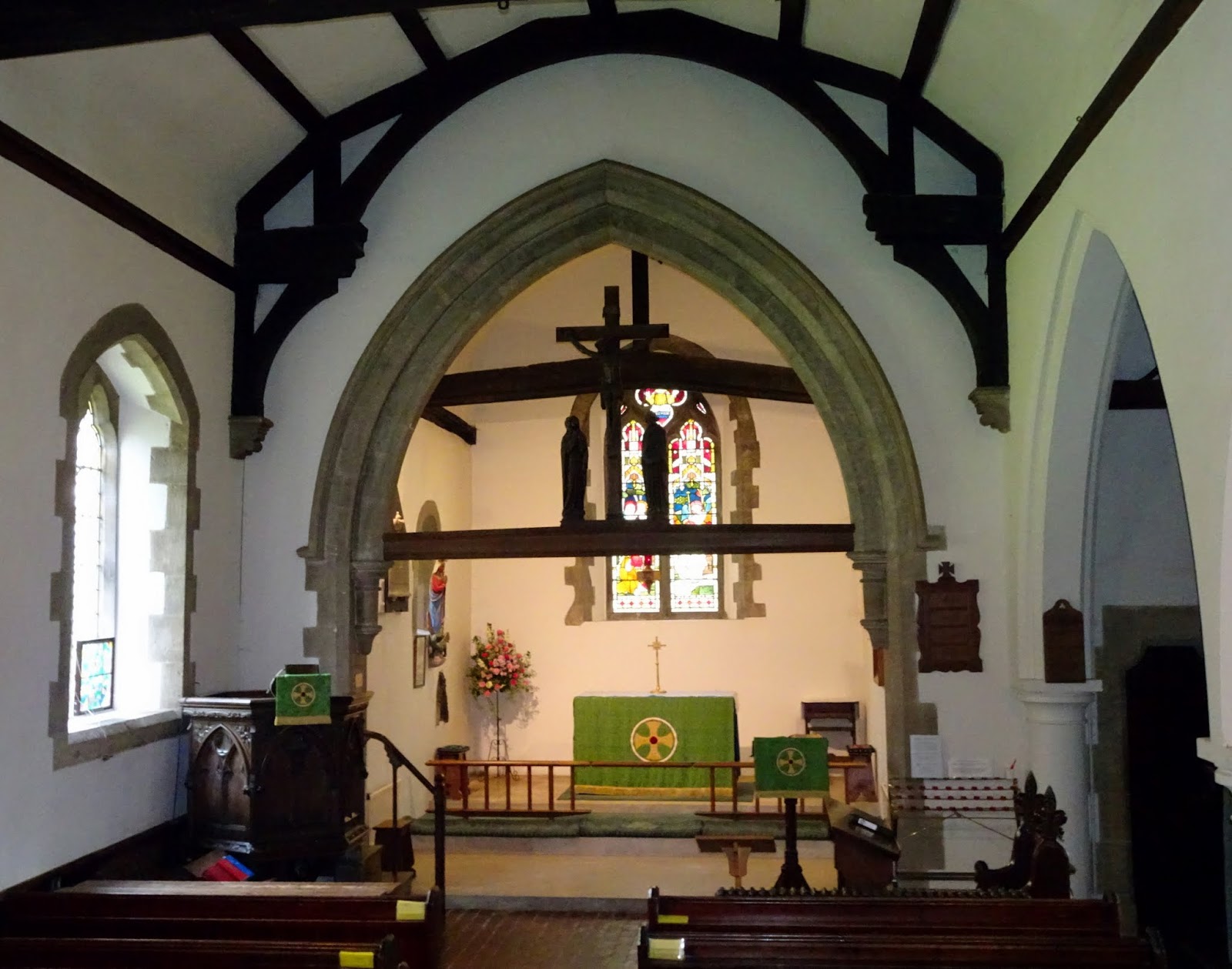
At Racton church, however, the royal arms remain in their original position over the roof beam that is the only division between nave and chancel, although the current arms are those of George II and date from the mid-18th century, as does the lovely lacy tracery on either side.

The royal arms could be very provocative in the centuries following the Reformation. At Burton church, the arms of Charles I are painted in the plaster with the admonition “Obey them that have the Rule over you, Heb, 13, 17” inscribed above. It was lucky the church was hidden within the park of the great house of the Royalist Goring family, or it would almost certainly have been erased in the Commonwealth years.

The arms of most monarchs since then are represented in local churches.
William III is in Aldingbourne, which also has the arms of George III. Both have been recently restored.


Queen Anne’s arms are at Midhurst.
The arms of George III with particularly lively lion and unicorn, are at Slindon.
Coats of arms were usually painted by itinerant sign painters whose main line of business was inn signs. Exposed to the weather, few inn signs survive so the royal arms in churches are often all we have of the work of these craftsmen.
According to Norman Pound’s History of the English Parish, it was never compulsory in law to put up the royal arms in churches, but curiously a big court case erupted over plans by many churches to put up the arms of Elizabeth II to celebrate the coronation in 1953.
West Tarring church in Worthing applied to the diocese for a faculty to erect the royal arms, which was granted, but the government then intervened saying the Queen’s permission was also needed. The Queen evidently approved, because her arms adorn the nave to this day.

Thursday, 11 June 2009

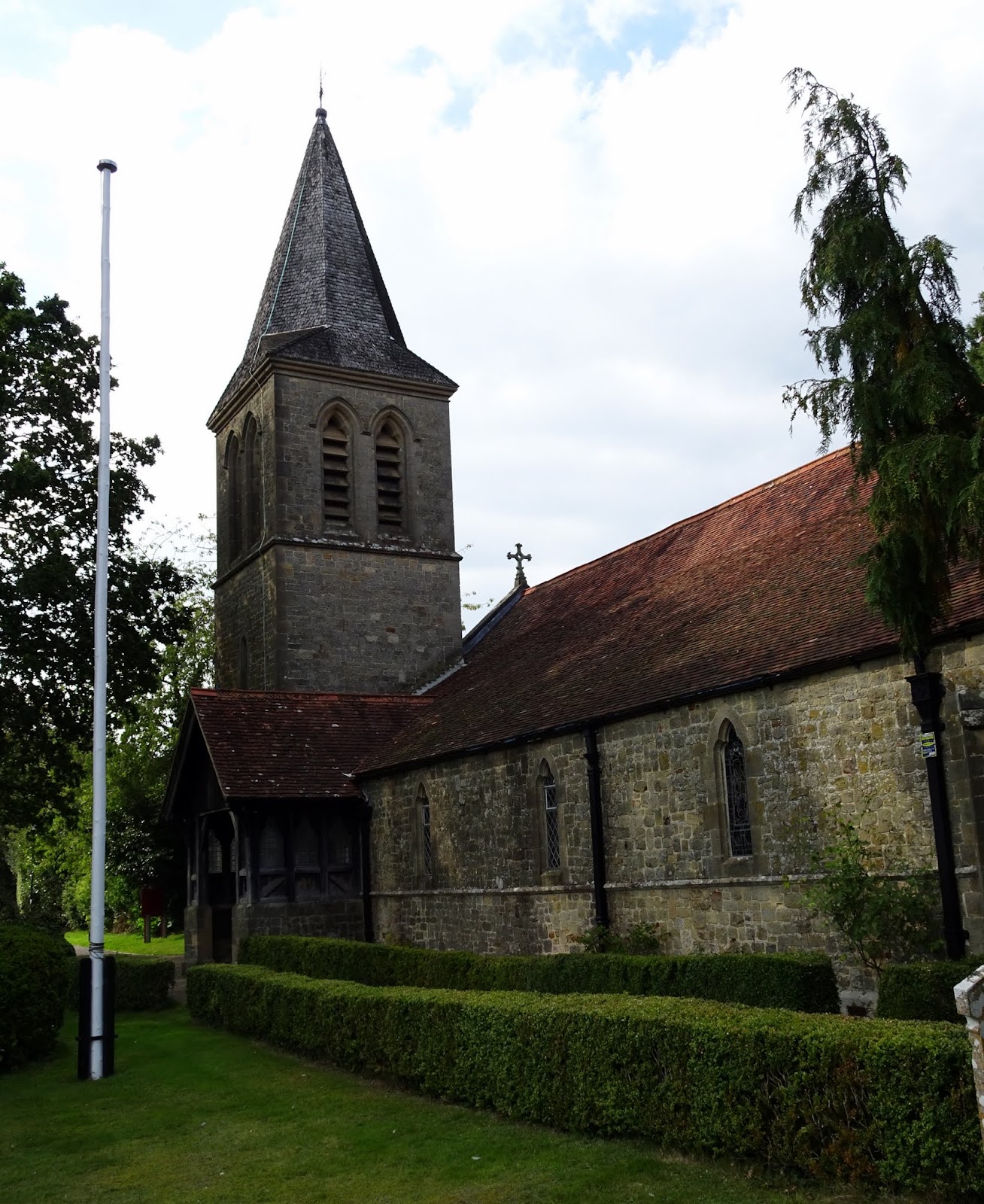
St Mary, Bepton

Bepton church sits under the Downs south of Midhurst as though immortal, but it has changed remarkably over the millennium since the first Christians in the area built the church mentioned in the Domesday Book.
The church was completely rebuilt in the 13th century with a simple but unusual plan: a west tower, a nave without aisles and a chancel the same width as the nave but separated from it by an arch (usually, if the chancel is the same width as the nave there is no arch).
There was trouble from the very start, as can be deduced from the fact that the walls of the tower are over three feet thick, but the tower is only as high as the roof ridge. Why were the walls so substantial for so short a tower?
It is believed that the original plan was for a much taller tower, but it began to subside during construction so the builders stopped as soon as they reached roof height, simply topping it off with a plain pyramidal roof.
Later, in about 1620, the tower began to lean again and it was shored up with two massive diagonal buttresses of brick. They have the effect of making it look even squatter.
In 1878 the north wall of the nave, the whole chancel and the south porch were all rebuilt by Lacy W. Ridge, so little of the 13th century remains. Little, except for one feature that is worth going to see in itself.
The tomb of one Rado de la Hedol is set in a niche with a lovely stone canopy dating from about 1300, as the Early English style morphed into the Decorated. The canopy has a ‘roof’ topped by a finial that in the Early English period would have consisted of formal, stiff leaves but this finial looks more like a bunch of shallots in a rubber band.
The crockets up the sides are all of different sizes, flame-like rather than leaf-like. The space under, known as the tympanum, is filled with cusped tracery. The composition is bold and vivid. Rado’s name and a worn brass plate carries an inscription in Lombardic letters calling for the Lord to have mercy on him (probably).

Monday, 4 May 2009

St Mary Magdalen, West Lavington

This is an important church, built in 1850 for the rector, Henry Manning, by William Butterfield. Manning preached his last sermon here before converting to the Roman Catholic church, where he rose to become Archbishop of Westminster and a cardinal.
Butterfield was working at the time on his masterpiece, All Saints Margaret Street in London, but here he uses the local Sussex style but in a typically forthright way.
Unfortunately, the church was made redundant in 2008 and access is no longer possible, apparently on safety grounds.

St Mary Magdalene and St Denys, Midhurst

The guidebooks are a bit dismissive about Midhurst's church. “A disappointment...there has been too much restoration” says Ian Nairn in Buildings of England. “Little left for us to see,” says Arthur Mee of The King's England.
The usual assumption is that Victorian architects (and their clients: the rectors, PCCs and benefactors) exercised their own egos by gratuitously altering and rebuilding ancient churches. But often they were presented with the same problems we find today.
In 1880, Midhurst church was in a bad state. The hodge-podge of additions over the centuries had created a space that was unusable for modern worship. It was too small for the growing congregation and the massive nave roof was forcing the walls out, threatening collapse.
The diocesan Surveyor of Ecclesiastical Dilapidations, Lacy W Ridge, was brought in to restore and update the church. Ridge had just restored the exterior of St Mary Appledram and went on to design several new churches in Sussex including ones at Burgess Hill and Brighton.
He enlarged the 16th century nave, lengthening it to the west and added a clerestory so it would be higher and lighter. The most prominent features of the exterior of the church are his – the west wall with its chequerboard stonework and traceried window, and the oddly-shaped broach spire.
The Perpendicular style chancel arcades and south aisle are original, as are the lower parts of the tower and the Southampton Chapel. Ridge cannot be blamed for the loss of the Southampton Chapel's glory: the Cowdray monuments that were removed to Easebourne in 1851.
But Ridge created a church that works. The western entrance was recently re-ordered so the main entrance is not directly off the traffic-infested street, but his changes have mostly stood the test of time.